


Where Did The Bible Come From? 🤔
- Dec 4, 2023
- 14 min read
QUESTION: How did God preserve His words to this day❓🤔
ANSWER: God preserved copies of His words down through time, using four main languages He chose for that purpose. All through history, God made several choices as to the languages in which He would communicate His message.

Choice 1: Hebrew
From at least as far back as Abraham (around 2000 BC) to the destruction of the second Temple in Jerusalem in 70 AD, God chose the Semitic languages, especially Hebrew, to communicate to His chosen people. God gave His law in Hebrew to teach men that they were sinners, and in need of a Saviour.
Choice 2: Greek
In the first century AD, God made a second choice. The main language of the world for three centuries had been Greek. God used that language to give the New Testament for the world to read. And it spread like wildfire. The devil recognized the huge potential of God’s Word in a “world” language, so he moved quickly to counter it.
He prepared a fake “Bible” in Alexandria, Egypt.

The Old Testament portion is commonly called the “Septuagint” [1] and the New Testament portion is called the “Alexandrian text.” This corruption was a “Greek” Bible, but with the poison of the Apocrypha mixed in, made to look like real scripture. The Alexandrian “Bible” also perverted the New Testament [2], taking out many of God’s words and substituting man’s ideas. This laid the groundwork for Satan’s plan to spread religious lies, and subvert the true faith.
Choice 3: Old Latin
From about 120 AD until the 1500s, God used a third language to communicate His truths, in addition to Hebrew and Greek. While the first copies of the New Testament in Greek were being made and passed around, God directed other Christians to translate His preserved words into Old Latin. This language was being spoken more and more in Europe, and became an “international” language as Greek had been. The Old Latin Bible was known as the “Vulgate,” which means “common Bible.” Once again, God’s words were spreading, and many Europeans began translating these Old Latin scriptures into their own languages. [3]
The devil responded by preparing a counterfeit “Vulgate” in Rome. By the 300s, the Roman religion claimed to be true Christianity, and a new “Bible” was made from the perverted Alexandrian writings. It included the Apocryphal books that the early church had rejected. But to make it convincing, they also put in some scriptures that were like the preserved Old Latin Bible as well. There were now two Latin “Vulgates,” dramatically different from one another.
The true Christians knew the difference between the true and the false “Vulgates.” [4] The devil knew what he had to do next. He had to destroy the true Latin Vulgate, and the people who held it so dearly. The Roman Catholic armies hunted down and martyred those who were caught possessing the true Latin Vulgate. But they were never able to completely replace the true Latin Vulgate with the corrupted Roman Catholic Latin Vulgate. God was preserving His words.
Choice 4: English
Around 700-800 AD, English, a new “world” language began to develop. God began laying the groundwork to use this language to trigger a massive missionary movement. In the 1500s William Tyndale worked to translate the Bible from the accurate Greek and Hebrew manuscripts that God had so carefully preserved. English-speaking people after him continued the effort to translate and perfect a Bible that matched the ancient scriptures. [5] One of the best of these is the Geneva Bible. English was a language in the midst of change. But by 1604 God used King James I [6] of England to commission a group of learned men [7] to accumulate scriptures in Hebrew, Greek, Latin and English as well as other languages. Their assignment was to translate [8] God’s words into the most accurate English possible. In early 1611 they published the Authorized Version, also known as the King James Bible. From the day it was published, the King James Bible circulated around the world, and missionaries translated Bibles from this precious book. [9]
The devil pulled out all the stops on this one. By the 1800s he had inspired a whole movement to discredit and destroy the King James Bible. Today, we have a multitude of translations that change, remove and add to God’s preserved words. But God has always kept the true scriptures in the hands of his people.
In making the four choices of language as described above, God was not trying to indicate that any single language was more expressive or better than another. Rather, He chose these languages because they suited His purpose at a particular time in history to carry out His plan. The choices were God’s. Outside of Israel, Hebrew was never a universal language. Ancient Greek is no longer a universal language, nor is Latin. But by guiding the production of a perfect Bible in English, God kept His promise. For our time, in a language read around the world, God preserved His words.

QUESTION: How do I show which Bible is correct to those who refuse to hear “King James only” arguments❓🤔
ANSWER: The key is to show them how the broad evidence of history tells us which Greek text is correct. It then becomes easy to know which Bible we can trust. First, please remember the simple fact that there are two streams of Bible history. The first line comes straight from the Apostles and people of Antioch. To date, 5,702 manuscripts, and the broad evidence of history support that line.
The Broad Evidence of History
This evidence for this stream spans from some of our oldest manuscripts to some of the least ancient. These manuscripts are in agreement with those of the persecuted believers, such as the Vaudois in the Alps northwest of Italy. They received the Scriptures from apostolic groups from Antioch of Syria about AD 120 and finished their translation by AD 157, according to Calvin’s successor, Theodore Beza. These manuscripts influenced one of the greatest events in Christian history: the Protestant Reformation.
The Polluted Stream
The other stream comes from questionable sources. About the time of Christ, a Jewish man named Philo decided to blend pagan Greek philosophy with Judaism.
The so-called “Christians” who came after him in Alexandria were not much better. Though they talked about “Jesus” and “Christianity,” they did not believe that Jesus was God. They also did not believe that the Old Testament detailed literal events. It was a school in this pagan city that decided to write their own copies of the Bible. The problem is that they changed the Scriptures, while saying they were copying them.
They used the heretic Marcion’s Lord’s Prayer in Luke, for example. From there it goes downhill. In truth there are only a handful of semi-complete “Bibles” from Alexandria, Egypt. The only other texts from there are literally pieces of paper. The grand total of manuscripts is only 44. Of those 44, only 3 are taken very seriously:
the Sinaiticus (Aleph),
the Alexandrinus (A)
and Vaticanus (B).
But there is a very big problem. It is rare that these three ever agree.
Between Sinaiticus and Vaticanus, for example, it is extremely difficult to find just two successive verses that agree. Look at the Lord’s Prayer in Luke again. Between codices Aleph, A [Alexandrinus], B [Vaticanus], C [Ephraemi Rescriptus] and D [Bezae Cantabrigiensis] there is no agreement in 32 out of 45 words. That means these major books only agree in 13 out of 45 words!
A Visual Image
Here’s one way to explain the difference between the manuscripts. Imagine a stadium with 5,746 people. 5,702 of them are in harmony, agreeing with one another and enjoying themselves. But there are also 44 other people. These are not like the first. They dislike the crowd around them and slander their words when they can. But they have another problem: they also disagree with each other. Which group would you rather listen to? The one with people in one accord, or the one that is filled with discord? The one that knows what it is saying, or the one that cannot agree on what it wants to say? The answer is obvious.
Where Do the Two Streams Lead?
A tree is known by its fruit. Where, then, do these two streams of Bibles lead? The Alexandrian manuscripts fell into disuse, and many were relegated to a desert trashcan. A number of “scholars” tried to make the expensive codices better by changing the words to be more like the other stream, but they finally gave up. Those are the many corrections we see in the Sinaiticus and Vaticanus.
But where do the Alexandrian manuscripts lead? Straight to the Roman Catholic institution.
They were used by Constantine with the help of Eusebius. They became the basis of the Apocrypha and many incorrect readings in the Roman Catholic Bible. They were used to dominate and subject true believers under a false religion. This was the Bible of the persecutors.
Alexandrian Bibles are legion. Such are the NIV, TNIV, NAS, CSB, ASV, ERV, TEV, GNB, Living, NCV, ISV, RSV, NRSV, etc., but also Catholic Bibles as the New American Bible, the Jerusalem and New Jerusalem Bibles.
The Antiochian manuscripts (from which we got the King James Bible) continued to be used and were passed down by faithful Christians from generation to generation. The Vaudois, for example, passed them down faithfully by even having their children memorize whole books of the Bible. These faithful people hand-copied little Bibles they could fit in their heavy garments. They were ready to give an answer, literally “in season and out of season”! And where do the Antiochian manuscripts lead? Straight to the Protestant Reformation. Wesley and writers of the Geneva Bible actually saw the Vaudois as a “pre-Reformation” group, even as the “two witnesses” who were protected by God in Revelation. That is how much they were indebted to these faithful.
Antiochian Bibles are easily recognizable. They are the Bibles of the Reformation: the Reina-Valera (Spanish), Diodati (Italian), Statenvertaling (Dutch), and all the other Protestant Bibles published between the 1530s and 1600s.
In English they are the Tyndale, Coverdale, Matthew’s, Great Bible, Bishops Bible, Geneva and King James.
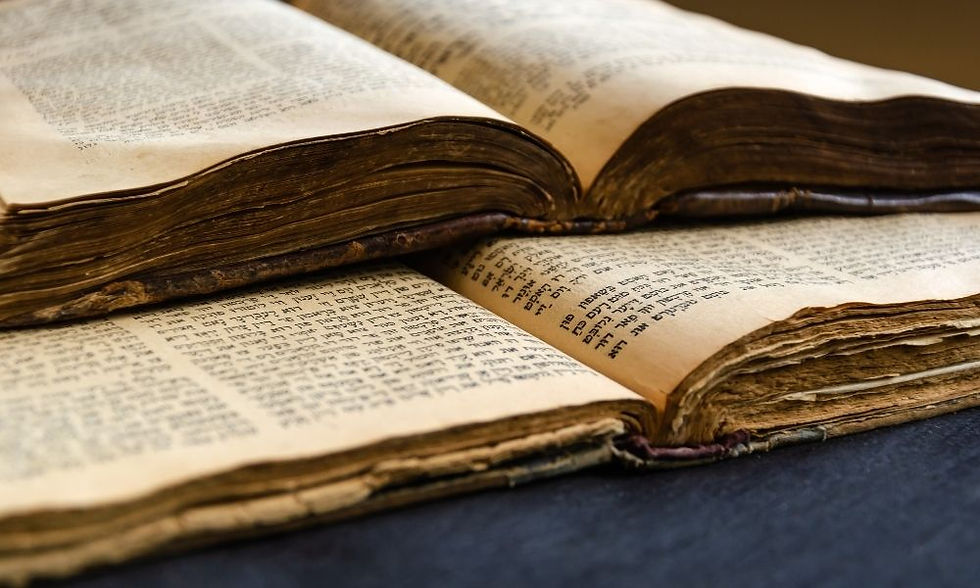
The fruit, for example, of the King James Bible in English is easily discernible. Look at many English-speaking Protestant denominations that were formed in an effort to get “back to the Bible.” The King James Bible was the starting point. The pilgrim Puritans in the USA switched from the Geneva to the King James in their next generation, despite the fact that they had used the Geneva since the 1560s. And ironically, the churches and Christians called “extreme Fundamentalists” and “right-wing extremists” are simply the churches that did not leave the fundamentals.
There are two kinds of churches:
those that left their founding doctrines
and those that stuck to them.
There are also two kinds of Bibles:
those that follow corrupt and perverted Alexandrian texts and/or Roman Catholic doctrine,
and those that follow the line of preservation through godly and persecuted Christian brethren.
The choice is obvious.
QUESTION: Why is the King James Bible called the “Authorized Version”❓ How was it authorized❓
ANSWER: Despite stories to the contrary, King James, in no uncertain terms, clearly authorized the translation of the Bible that now bears his name.
[Note: This is a drastically shortened account of the birth of God’s preserved words in English. Longer accounts are available, as in Final Authority: A Christian’s Guide to the King James Bible, by William P. Grady, available from Chick Publications.]
Sanctioning the Authorized Version
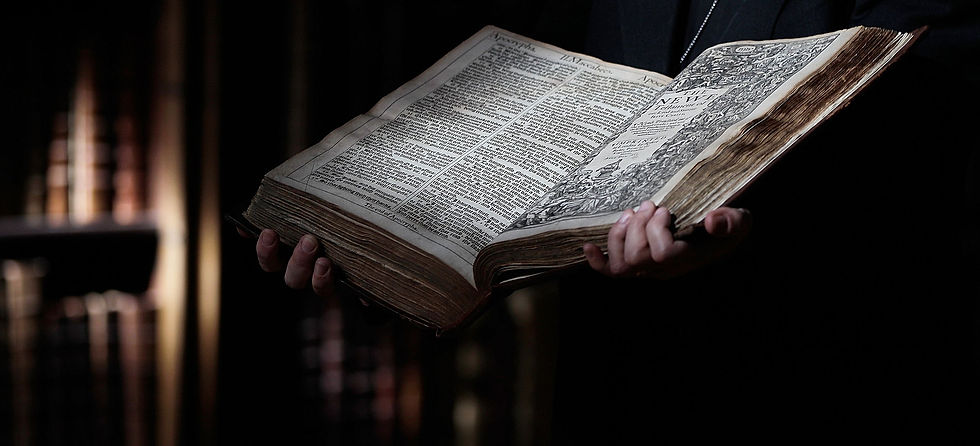
When Elizabeth I died on April 1, 1603, she had seen 130 editions of the New Testament and the Bible published during her 45 years as Queen of England. James VI of Scotland, son of Mary, “Queen of Scots,” became James I of England. Four days later, on his way to London, a delegation of Puritan ministers met James, asking him to hear their grievances against the Church of England. James consented, and on January of 1604, four Puritans came to express their troubles at Hampton Court, in front of King James and over 50 Anglican (Church of England) officials. One by one each request was rejected, until the Puritan group’s leader, John Rainolds said these famous words:
“May your Majesty be pleased to direct that the Bible be now translated, [since] such versions as are extant [are] not answering to the original.”
At first, Bishop Bancroft of London was dead-set against it, saying, “If every man’s humor might be followed, there would be no end to translating.” But the King made it clear he liked the idea. Not too long later Bancroft wrote this to a friend:
"I move you in his majesty’s name that… no time may be overstepped by you for the better furtherance of this holy work… You will scarcely conceive how earnest his majesty is to have this work begun!"
When this Bible was translated, the title page was printed basically as you find it today in Cambridge Bibles:
THE
HOLY BIBLE
CONTAINING THE
OLD AND NEW TESTAMENTS
TRANSLATED OUT OF THE ORIGINAL TONGUES: AND WITH THE FORMER TRANSLATIONS
DILIGENTLY COMPARED AND REVISED
BY HIS MAJESTY’S SPECIAL COMMAND
APPOINTED TO BE READ IN CHURCHES
The King James Bible was “Authorized” to be translated as God’s Word for the English-speaking people of the world.
QUESTION: Who were the translators of the King James Bible❓
ANSWER: God brought together over 54 of the finest Bible translators English has ever known, to translate the King James Bible.

Researching the Translators
For twenty years (the 1830s to the 1850s) researcher Alexander McClure pored over records to learn all he could about who translated the King James Bible. His resulting book, Translators Revived: A Biographical Memoir of the Authors of the English Version of the Holy Bible [10], stands as a monument to these dedicated Christian men. I highly recommend it.
A Few Short Examples
Here are some of the qualified translators of the King James Bible.
John Harman, M.A., New College, Oxford
In 1585 he had been appointed King’s Professor of Greek. He had published Latin translations of Calvin’s and Beza’s sermons, and was also adept in Greek. He was a member of the New Testament group that met at Oxford.
John Spencer
At 19 years of age he had been elected Greek lecturer for Corpus Christi College in Oxford University. It was written of him, “Of his eminent scholarship there can be no question.” He was a member of the New Testament group (Romans through Jude) that met at Westminster.
Thomas Bilson
McClure wrote that he was “so complete in divinity, so well skilled in languages, so read in the Fathers and Schoolmen, so judicious in making use of his readings, that at length he was found to be no longer a soldier, but commander in chief in the spiritual warfare” (Translators Revived, pp. 214-416).
Dr. George Abbot, B.D., D.D.
Dr. Abbot started at Oxford in 1578, getting his B.D. in 1593 and at 35 years of age both received his doctorate and became first Master of University College, and later Vice Chancellor. He became Bishop of Lichfield in 1609 and Archbishop of Canterbury in 1611. He was regarded as “the head of the Puritans within the Church of England.” He was in the Oxford New Testament group.
Sir Henry Saville
In 1565 Sir Saville was Fellow of Merton College and Warden in 1585. By 1596 he was Provost of Eton College and tutor to Queen Elizabeth I. He founded the Savillian professorships of Mathematics and Astronomy at Oxford. His many works include an 8-volume set of the writings of Chrysostom [11]. He also worked in the New Testament group at Oxford.
Lancelot Andrewes
From Terence H. Brown, (Secretary of the Trinitarian Bible Society, London, England) comes this description of Westminster committee member Lancelot Andrewes:
He “... had his early education at Coopers Free School and Merchant Taylors School, where his rapid progress in the study of the ancient languages was brought to the notice of Dr. Watts, the founder of some scholarships at Pembroke Hall, Cambridge. Andrewes was sent to that College, where he took his B.A. degree and soon afterward was elected Fellow. He then took his Master’s degree and began to study divinity and achieved great distinction as a lecturer. He was raised to several positions of influence in the Church of England and distinguished himself as a diligent and excellent preacher, and became Chaplain to Queen Elizabeth I. King James I promoted him to be Bishop of Chester in 1605 and also gave him the influential position of Lord Almoner. He later became Bishop of Ely and Privy Counsellor. Toward the end of his life he was made Bishop of Winchester.
“It is recorded that Andrewes was a man of deep piety and that King James had such great respect for him that in his presence he refrained from the levity in which he indulged at other times. A sermon preached at Andrewes’ funeral in 1626 paid tribute to his great scholarship:
‘His knowledge in Latin, Greek, Hebrew, Chaldee, Syriac and Arabic, besides fifteen modern languages was so advanced that he may be ranked as one of the rarest linguists in Christendom. A great part of five hours every day he spent in prayer, and in his last illness he spent all his time in prayer – and when both voice and eyes and hands failed in their office, his countenance showed that he still prayed and praised God in his heart, until it pleased God to receive his blessed soul to Himself.’”
Transcending Their Human Limits
Gustavus S. Paine, author of The Men Behind the King James Version, made this assessment about the work of the combined translators:
“Though we may challenge the idea of word-by-word inspiration, we surely must conclude that these were men able, in their profound moods, to transcend their human limits. In their own words, they spake as no other men spake because they were filled with the Holy Ghost. Or, in the clumsier language of our time, they so adjusted themselves to each other and to the work as to achieve a unique coordination and balance, functioning thereafter as an organic entity–no mere mechanism equal to the sum of its parts, but a whole greater than all of them. [12] While these scholars were perfectly suited for the task of translation individually, they still had to agree on every single word of the Bible. That meant man’s mere opinion could not be allowed to stand in the text.
The One Who Started It All
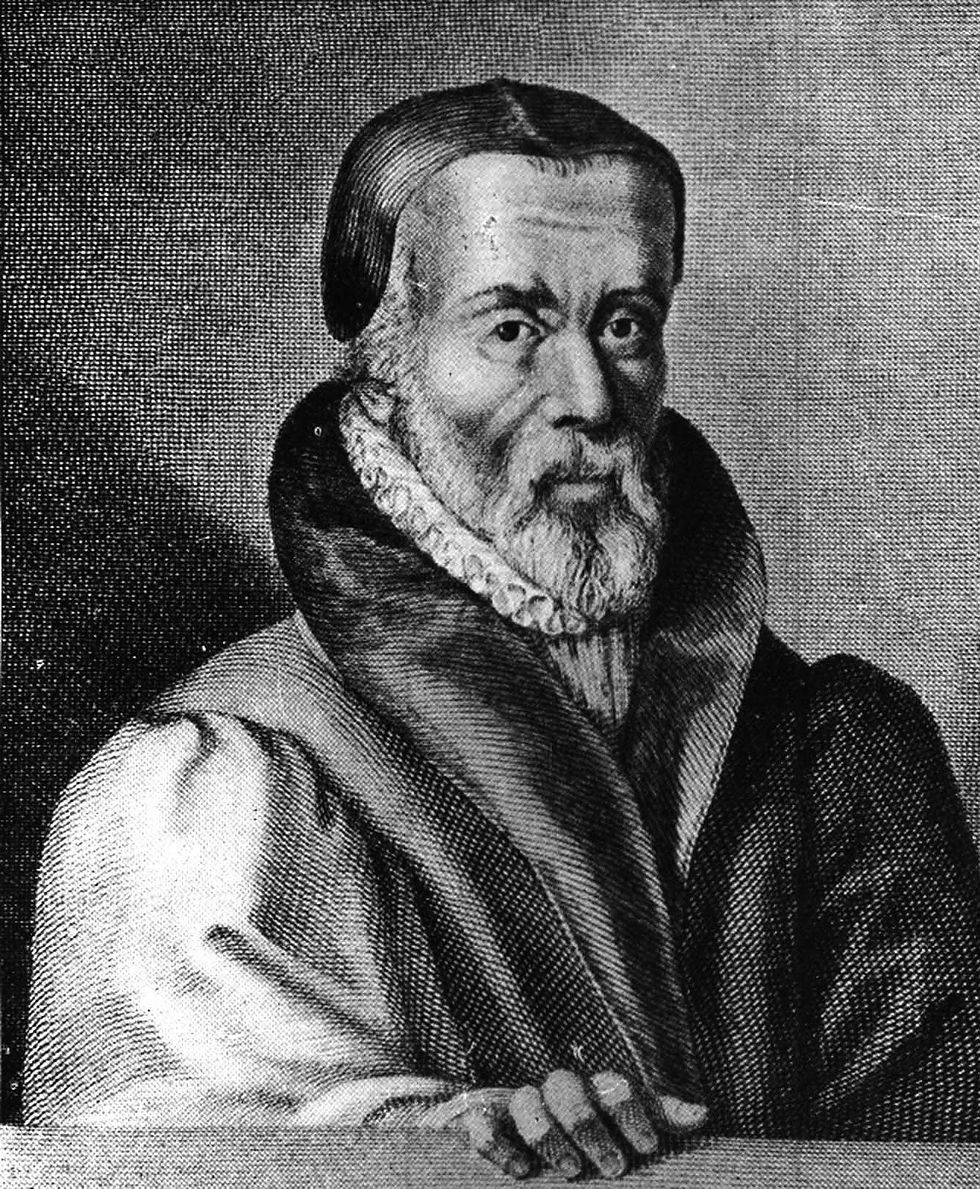
But these translators were standing on the shoulders of great men and Christians who went before them. And one man did more for the English Bible than any single person before or since: William Tyndale. He was ordained a priest around his late teens, in 1502. By 1515 he had earned his M.A. at Oxford and later transferred to Cambridge. It was there that he came upon the preserved Greek New Testament of Erasmus, and at the same time as Martin Luther, he came to understand the truth of the gospel. Tyndale began preaching and teaching the gospel message, which made the Roman Catholics angry with him, branding him a heretic. One day, while proving a “learned” Roman Catholic scholar wrong, the papist cried out, “It were better for us to be without God’s laws, than without the Pope’s!” To which Tyndale prophetically replied,
“I defy the Pope, and all his laws; and if God spare my life, ere many years, I will cause a boy that driveth the plough to know more of the Scripture than thou dost!”
This changed Tyndale forever. He wrote about this incident,
“Which thing only moved me to translate the New Testament. Because I had perceived by experience, how that it was impossible to establish the lay people in any truth, except the Scriptures were plainly laid before their eyes in the mother tongue” (Translators Revived, p. 23).
Tyndale was well suited to his task. Spalatin, a friend of Martin Luther, wrote this in his diary of what professor Herman Buschius told him about Tyndale and his New Testament:
“The work was translated by an Englishman staying there with two others,–a man so skilled in the seven languages, Hebrew, Greek, Latin, Italian, Spanish, English, and French, that which-ever he spake, you would suppose it his native tongue” (Translators Revived, pp. 27-28)
By the time Tyndale was betrayed by his friend, imprisoned and nearly frozen during a cold winter in his cell, he had translated the New Testament into English, along with some Old Testament books, and had trained at least two others to carry on his work. But he wasn’t finished. Even when burnt at the stake on October 6, 1536, he cried out prophetically:
“Lord! Open the King of England’s eyes” [13]
That very day a copy of Tyndale’s New Testament was being printed by the King’s own printer!

Conclusion
Tyndale’s work of translation was so excellent that easily 70% of the words of the Bible are Tyndale’s. God had set the standard.
Over the next century, God’s preserved words were translated and revised by many scholars, a great many “good translations.” These, along with God’s preserved words in Italian, Spanish, French, Dutch and other languages were all “good translations.” But the goal of the king’s translators of 1604-1611 was not to write a new Bible from scratch, nor was it to make a translation from the Roman Catholic perversions:
“Truly, good Christian Reader, we never thought from the beginning that we should need to make a new translation, nor yet to make of a bad one a good one; … but to make a good one better, or out of many good ones one principal good one, not justly to be excepted against; that hath been our endeavor, that our mark” (The Translators to the Reader, 1611 KJV, ninth page).
And that is exactly what God did. Throughout history God preserved His words. And culminating with over 54 dedicated, learned Christian men, God put His words in English in its perfection in one final translation: The King James Bible.

Source Material: Answers To Your Bible Version Questions, by David W. Daniels
Comments